Did You Achieve Your Rto? What Steps and Procedures Can You Implement to Help Drive Rto Even Lower?
Disaster recovery involves a set of policies, tools, and procedures to enable the recovery or continuation of vital technology infrastructure and systems following a natural or human-induced disaster. Disaster recovery focuses on the information technology (IT) or technology systems supporting critical concern functions,[i] as opposed to business continuity, which involves keeping all essential aspects of a business functioning despite pregnant disruptive events; it can therefore exist considered a subset of business continuity.[2] [3]Disaster recovery assumes that the primary site is non recoverable for some fourth dimension and represents a process of restoring information and services to a secondary survived site, which is reverse to the process of restoring back to its original place.
Information technology service continuity [edit]
IT Service Continuity [4] [5] (ITSC) is a subset of business continuity planning (BCP)[6] that focuses on Recovery Point Objective (RPO) and Recovery Fourth dimension Objective (RTO). It encompasses two kinds of planning; IT disaster recovery planning and wider Information technology resilience planning. Additionally, it too incorporates elements of Information technology infrastructure and services that relate to communications, such equally (voice) telephony and information communications.
Principles of backup sites [edit]
Planning includes arranging for backup sites, whether they are hot, warm, or common cold, and standby sites with hardware as needed for continuity.
In 2008, the British Standards Institution launched a specific standard connected and supporting the Business Continuity Standard BS 25999, titled BS25777, specifically to align computer continuity with business organization continuity. This was withdrawn following the publication in March 2011 of ISO/IEC 27031 "Security techniques — Guidelines for data and communication engineering readiness for business concern continuity".[seven]
ITIL has divers some of these terms.[8]
Recovery Time Objective [edit]
The Recovery Time Objective (RTO)[9] [ten] is the targeted duration of time and a service level within which a business procedure must be restored after a disaster (or disruption) in order to avoid unacceptable consequences associated with a break in concern continuity.[eleven]
According to business continuity planning methodology, the RTO is established during the Business Affect Analysis (BIA) past the owner(s) of the process, including identifying time frames for alternate or transmission workarounds.
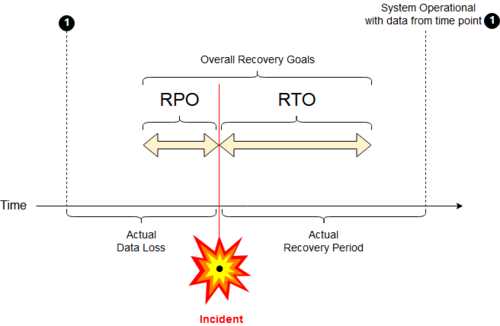
Schematic representation of the terms RPO and RTO. In this example, the agreed values of RPO and RTO are non fulfilled.
Literature on the subject refers to RTO as a complement of Recovery Point Objective (RPO), with two metrics describing the limits of acceptable or "tolerable" ITSC performance. RTO and RPO gauges ITSC operation in terms of time lost from normal business process functioning and data lost or not backed upwards during that period (RPO), respectively. [11] [12]
Recovery Fourth dimension Actual [edit]
A Forbes overview[nine] noted Recovery Time Bodily (RTA) is, in fact, the critical metric for business continuity and disaster recovery.
The business concern continuity group conducts timed rehearsals (or actuals), during which RTA gets determined and refined every bit needed.[9] [thirteen]
Recovery Signal Objective [edit]
A Recovery Point Objective (RPO) is the maximum targeted menstruation during which transactional information is lost from an IT service due to a major incident.[xi]
For example, in the case, RPO is measured in minutes (or even a few hours), then in practice, off-site mirrored backups must be continuously maintained equally a daily off-site backup on tape will not suffice..[fourteen]
Human relationship to Recovery Time Objective [edit]
A recovery that is not instantaneous volition restore transactional information over some time and do so without incurring significant risks or losses.[xi]
RPO measures the maximum time in which recent data might have been permanently lost in the event of a major incident and is non a straight measure out of the quantity of such loss. For example, if the BC programme, to restore upward to the final bachelor fill-in, then the RPO is the maximum interval betwixt such backups that take been safely vaulted off-site.
It is often misinterpreted that RPO is determined by the existing backup regime, whereas in reality, Business bear on analysis determines RPO for each service. When off-site data is required, the period during which data might be lost often starts when backups are prepared, not when the backups are taken off-site.[12]
Data synchronization points [edit]
A data synchronization point[15] is a signal in time when physical data is backed upward. It is one of the approaches used to halt the processing of an update queue, while a disk-to-deejay copy is being fabricated. The fill-in[xvi] re-create would reflect the before version of the copy functioning; not when the data is copied to tape or transmitted elsewhere.
How RTO and RPO values bear upon computer system design [edit]
RTO and the RPO must be balanced, taking concern run a risk into account, along with all the other major system design criteria.[17]
RPO is tied to the times' backups are sent offsite. Offsiting via synchronous copies to an offsite mirror allows for near unforeseen difficulty. The utilise of physical transportation for tapes (or other transportable media) comfortably covers some fill-in needs at a relatively low cost. Recovery can be enacted at a predetermined site. Shared offsite space and hardware consummate the packet needed. [eighteen]
For high volumes of high-value transaction data, the hardware can be split up across two or more than sites by splitting beyond geographic areas adds resiliency.
History [edit]
Planning for disaster recovery and information engineering science (IT) developed in the mid to late 1970s equally estimator eye managers began to recognize the dependence of their organizations on their computer systems.
At that time, most systems were batch-oriented mainframes. Another offsite mainframe could be loaded from backup tapes pending recovery of the primary site; downtime was relatively less disquisitional.
The disaster recovery industry[19] [20] developed to provide backup computer centers. One of the earliest such centers was located in Sri Lanka (Sungard Availability Services, 1978).[21] [22]
During the 1980s and 90s, as internal corporate timesharing, online data entry and real-time processing grew, more availability of IT systems was needed.
Regulatory agencies became involved fifty-fifty before the rapid growth of the Internet during the 2000s; objectives of ii, 3, iv or 5 nines (99.999%) were oftentimes mandated, and high-availability solutions for hot-site facilities were sought.[ citation needed ]
Information technology Service Continuity is essential for many organizations in the implementation of Business Continuity Management (BCM) and Information Security Direction (ICM) and as part of the implementation and operation information security management equally well every bit business continuity direction as specified in ISO/IEC 27001 and ISO 22301 respectively.
The rise of cloud computing since 2010 continues that trend: nowadays, it matters even less where calculating services are physically served, simply so long as the network itself is sufficiently reliable (a separate issue, and less of a business organisation since modern networks are highly resilient by design). 'Recovery as a Service' (RaaS) is one of the security features or benefits of cloud calculating being promoted past the Cloud Security Brotherhood.[23]
Nomenclature of disasters [edit]
Disasters can exist the result of three broad categories of threats and hazards. The first category is natural hazards that include acts of nature such as floods, hurricanes, tornadoes, earthquakes, and epidemics. The 2nd category is technological hazards that include accidents or the failures of systems and structures such as pipeline explosions, transportation accidents, utility disruptions, dam failures, and accidental hazardous fabric releases. The third category is human being-acquired threats that include intentional acts such as active assailant attacks, chemical or biological attacks, cyber attacks against data or infrastructure, and sabotage. Preparedness measures for all categories and types of disasters fall into the v mission areas of prevention, protection, mitigation, response, and recovery.[24]
Importance of disaster recovery planning [edit]
Recent research supports the idea that implementing a more holistic pre-disaster planning approach is more than cost-effective in the long run. Every $1 spent on hazard mitigation (such as a disaster recovery plan) saves society $4 in response and recovery costs.[25]
2015 disaster recovery statistics advise that downtime lasting for one 60 minutes can cost
- pocket-size companies as much as $8,000,
- mid-size organizations $74,000, and
- large enterprises $700,000.[26]
As Information technology systems accept become increasingly critical to the polish functioning of a company, and arguably the economy as a whole, the importance of ensuring the continued operation of those systems, and their rapid recovery, has increased. For case, of companies that had a major loss of business data, 43% never reopen and 29% close within two years.[ citation needed ] As a consequence, preparation for continuation or recovery of systems needs to exist taken very seriously. This involves a meaning investment of time and money with the aim of ensuring minimal losses in the event of a disruptive consequence.[27]
Control measures [edit]
Control measures are steps or mechanisms that can reduce or eliminate various threats for organizations. Different types of measures tin exist included in a disaster recovery program (DRP).
Disaster recovery planning is a subset of a larger process known as business organisation continuity planning and includes planning for resumption of applications, data, hardware, electronic communications (such equally networking), and other It infrastructure. A business continuity plan (BCP) includes planning for not-Information technology related aspects such equally central personnel, facilities, crunch advice, and reputation protection and should refer to the disaster recovery program (DRP) for Information technology-related infrastructure recovery/continuity.
IT disaster recovery control measures can be classified into the post-obit three types:
- Preventive measures – Controls aimed at preventing an event from occurring.
- Detective measures – Controls aimed at detecting or discovering unwanted events.
- Corrective measures – Controls aimed at correcting or restoring the system after a disaster or an consequence.
Good disaster recovery program measures dictate that these 3 types of controls exist documented and exercised regularly using so-called "DR tests".
Strategies [edit]
Prior to selecting a disaster recovery strategy, a disaster recovery planner outset refers to their arrangement's business continuity program, which should indicate the cardinal metrics of Recovery Point Objective and Recovery Time Objective.[28] Metrics for business processes are then mapped to their systems and infrastructure.[29]
Failure to properly programme can extend the disaster'south touch on.[30] Once metrics accept been mapped, the arrangement reviews the Information technology budget; RTO and RPO metrics must fit with the bachelor budget. A cost-benefit assay often dictates which disaster recovery measures are implemented.
Adding cloud-based backup to the benefits of local and offsite tape archiving, the New York Times wrote, "adds a layer of data protection."[31]
Common strategies for data protection include:
- backups made to record and sent off-site at regular intervals
- backups made to disk on-site and automatically copied to off-site disk, or made direct to off-site deejay
- replication of data to an off-site location, which overcomes the need to restore the data (simply the systems then demand to be restored or synchronized), ofttimes making apply of storage area network (SAN) engineering science
- Individual Deject solutions which replicate the direction data (VMs, Templates and disks) into the storage domains which are part of the private cloud setup. These management data are configured as a xml representation called OVF (Open Virtualization Format), and can exist restored once a disaster occurs.
- Hybrid Cloud solutions that replicate both on-site and to off-site data centers. These solutions provide the power to instantly fail-over to local on-site hardware, but in the consequence of a physical disaster, servers can be brought upwardly in the cloud data centers equally well.
- the utilize of high availability systems which keep both the data and organisation replicated off-site, enabling continuous access to systems and data, even later on a disaster (often associated with cloud storage)[32]
In many cases, an system may elect to use an outsourced disaster recovery provider to provide a stand-by site and systems rather than using their ain remote facilities, increasingly via deject computing.
In addition to preparing for the demand to recover systems, organizations likewise implement precautionary measures with the objective of preventing a disaster in the kickoff place. These may include:
- local mirrors of systems and/or data and utilize of disk protection technology such as RAID
- surge protectors — to minimize the effect of power surges on frail electronic equipment
- use of an uninterruptible power supply (UPS) and/or backup generator to keep systems going in the result of a power failure
- fire prevention/mitigation systems such equally alarms and fire extinguishers
- anti-virus software and other security measures
Disaster recovery equally a service [edit]
Disaster recovery as a service (DRaaS) is an arrangement with a third party, a vendor.[33] Commonly offered by Service Providers as role of their service portfolio.
Although vendor lists have been published, disaster recovery is not a product, it's a service, even though several large hardware vendors take developed mobile/modular offerings that can be installed and made operational in very curt fourth dimension.[ original inquiry? ]

A modular data middle connected to the power grid at a utility substation
- Cisco Systems[34]
- Google (Google Modular Data Center) has developed systems that could exist used for this purpose.[35] [36]
- Bull (mobull)[37]
- HP (Performance Optimized Datacenter)[38]
- Huawei (Container Data Centre Solution),[39]
- IBM (Portable Modular Data Middle)
- Schneider-Electric (Portable Modular Data Centre)
- Sun Microsystems (Lord's day Modular Datacenter)[40]
- SunGard Availability Services
- ZTE Corporation
Run across also [edit]
- Backup site
- Business continuity
- Business concern continuity planning
- Continuous data protection
- Disaster recovery plan
- Disaster response
- Emergency management
- Loftier availability
- Information System Contingency Plan
- Real-time recovery
- Recovery Consistency Objective
- Remote fill-in service
- Virtual record library
- BS 25999
References [edit]
- ^ Systems and Operations Continuity: Disaster Recovery. Georgetown Academy. University Information Services. Retrieved 3 August 2012.
- ^ Disaster Recovery and Business Continuity, version 2011. Archived January 11, 2013, at the Wayback Automobile IBM. Retrieved 3 Baronial 2012.
- ^ [1] 'What is Business Continuity Management', DRI International, 2017
- ^ M. Niemimaa; Steven Buchanan (March 2017). "Information systems continuity procedure". ACM.com (ACM Digital Library).
- ^ "2017 It Service Continuity Directory" (PDF). Disaster Recovery Journal.
- ^ "Defending The Data Strata". ForbesMiddleEast.com. Dec 24, 2013.
- ^ "ISO 22301 to exist published Mid May - BS 25999-2 to be withdrawn". Business Continuity Forum. 2012-05-03. Retrieved 2021-eleven-20 .
- ^ "ITIL glossary and abbreviations".
- ^ a b c "Like The NFL Draft, Is The Clock The Enemy Of Your Recovery Fourth dimension". Forbes. Apr 30, 2015.
- ^ "Three Reasons You Tin can't Meet Your Disaster Recovery Time". Forbes. Oct 10, 2013.
- ^ a b c d "Agreement RPO and RTO". DRUVA. 2008. Retrieved February 13, 2013.
- ^ a b "How to fit RPO and RTO into your backup and recovery plans". SearchStorage . Retrieved 2019-05-20 .
- ^ "Clock... modifications
- ^ Richard May. "Finding RPO and RTO". Archived from the original on 2016-03-03.
- ^ "Information transfer and synchronization betwixt mobile systems". May fourteen, 2013.
- ^ "Subpoena #v to Southward-1". SEC.gov.
real-fourth dimension ... provide redundancy and back-up to ...
- ^ Peter H. Gregory (2011-03-03). "Setting the Maximum Tolerable Downtime -- setting recovery objectives". It Disaster Recovery Planning For Dummies. Wiley. pp. xix–22. ISBN978-1118050637.
- ^ William Caelli; Denis Longley (1989). Information Security for Managers. p. 177. ISBN1349101370.
- ^ "Catastrophe? It Tin can't Perhaps Happen Here". The New York Times. January 29, 1995.
.. patient records
- ^ "Commercial Property/Disaster Recovery". NYTimes.com. October 9, 1994.
...the disaster-recovery industry has grown to
- ^ Charlie Taylor (June 30, 2015). "US tech firm Sungard announces 50 jobs for Dublin". The Irish Times.
Sungard .. founded 1978
- ^ Cassandra Mascarenhas (November 12, 2010). "SunGard to exist a vital presence in the banking manufacture". Wijeya Newspapers Ltd.
SunGard ... Sri Lanka'south time to come.
- ^ SecaaS Category nine // BCDR Implementation Guidance CSA, retrieved xiv July 2014.
- ^ "Threat and Hazard Identification and Risk Assessment (THIRA) and Stakeholder Preparedness Review (SPR): Guide Comprehensive Preparedness Guide (CPG) 201, 3rd Edition" (PDF). The states Department of Homeland Security. May 2018.
- ^ "Mail service-Disaster Recovery Planning Forum: How-To Guide, Prepared by Partnership for Disaster Resilience". University of Oregon'due south Community Service Eye, (C) 2007, world wide web.OregonShowcase.org. Retrieved October 29, 2018.
- ^ "The Importance of Disaster Recovery". Retrieved Oct 29, 2018.
- ^ "IT Disaster Recovery Plan". FEMA. 25 October 2012. Retrieved 11 May 2013.
- ^ "Use of the Professional person Practices framework to develop,implement,maintain a business organisation continuity program can reduce the likelihood of significant gaps". DRI International. 2021-08-16. Retrieved 2021-09-02 .
- ^ Gregory, Peter. CISA Certified Information Systems Auditor All-in-Ane Exam Guide, 2009. ISBN 978-0-07-148755-9. Page 480.
- ^ "Five Mistakes That Tin Kill a Disaster Recovery Plan". Dell.com. Archived from the original on 2013-01-16. Retrieved 2012-06-22 .
- ^ J. D. Biersdorfer (Apr 5, 2018). "Monitoring the Health of a Fill-in Drive". The New York Times.
- ^ Brandon, John (23 June 2011). "How to Apply the Cloud as a Disaster Recovery Strategy". Inc . Retrieved 11 May 2013.
- ^ "Disaster Recovery as a Service (DRaaS)".
- ^ "Info and video about Cisco's solution". Datacentreknowledge. May 15, 2007. Archived from the original on 2008-05-19. Retrieved 2008-05-11 .
- ^ Kraemer, Brian (June eleven, 2008). "IBM'south Project Big Green Takes Second Step". ChannelWeb. Archived from the original on 2008-06-11. Retrieved 2008-05-11 .
- ^ "Modular/Container Data Centers Procurement Guide: Optimizing for Energy Efficiency and Quick Deployment" (PDF). Archived from the original (PDF) on 2013-05-31. Retrieved 2013-08-30 .
- ^ Kidger, Daniel. "Mobull Plug and Boot Datacenter". Bull. Archived from the original on 2010-11-19. Retrieved 2011-05-24 .
- ^ "HP Performance Optimized Datacenter (POD) 20c and 40c - Product Overview". H18004.www1.hp.com. Archived from the original on 2015-01-22. Retrieved 2013-08-thirty .
- ^ "Huawei'due south Container Data Center Solution". Huawei. Retrieved 2014-05-17 .
- ^ "Technical specs of Sun'southward Blackbox". Archived from the original on 2008-05-13. Retrieved 2008-05-11 .
Further reading [edit]
- Barnes, James (2001). A guide to business organization continuity planning. Chichester, NY: John Wiley. ISBN9780470845431. OCLC 50321216.
- Bell, Judy Kay (2000). Disaster survival planning : a practical guide for businesses. Port Hueneme, CA, US: Disaster Survival Planning. ISBN9780963058027. OCLC 45755917.
- Fulmer, Kenneth (2015). Business Continuity Planning : a Step-by-Step Guide With Planning Forms. Brookfield, CT: Rothstein Associates, Inc. ISBN9781931332804. OCLC 712628907, 905750518, 1127407034.
- DiMattia, Susan S (2001). "Planning for Continuity". Library Journal. 126 (19): 32–34. ISSN 0363-0277. OCLC 425551440.
- Harney, John (July–August 2004). "Business Continuity and Disaster Recovery: Support Or Close Down". AIIM East-DOC Magazine. ISSN 1544-3647. OCLC 1058059544. Archived from the original on 2008-02-04.
- "ISO 22301:2019(en), Security and resilience — Business continuity management systems — Requirements". ISO.
- "ISO/IEC 27001:2013(en) Information applied science — Security techniques — Information security management systems — Requirements". ISO.
- "ISO/IEC 27002:2013(en) Information technology — Security techniques — Code of practice for information security controls". ISO.
External links [edit]
- "Glossary of terms for Business Continuity, Disaster Recovery and related data mirroring & z/OS storage technology solutions". recoveryspecialties.com. Archived from the original on 2020-11-14. Retrieved 2021-09-02 .
- "It Disaster Recovery Programme". Fix.gov . Retrieved 2021-09-02 .
- "RPO (Recovery Point Objective) Explained". IBM. 2019-08-08. Retrieved 2021-09-02 . 125.27.81.202 (talk) thirteen:xviii, three April 2022 (UTC)
Source: https://en.wikipedia.org/wiki/Disaster_recovery
0 Response to "Did You Achieve Your Rto? What Steps and Procedures Can You Implement to Help Drive Rto Even Lower?"
ارسال یک نظر